Cuenca de Los Ojos
Managing the conservation of private ranches in northern Sonora
The Project
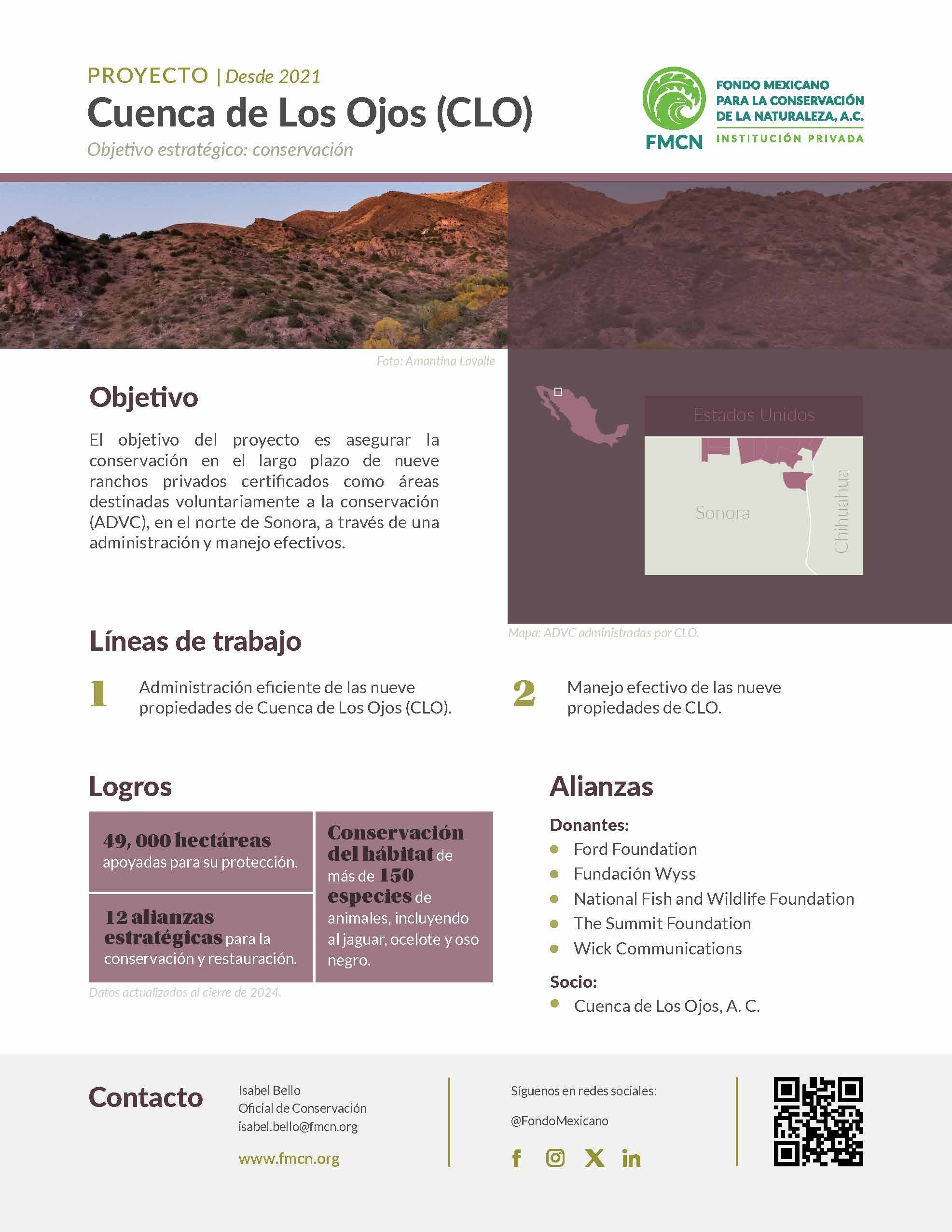
Cuenca de Los Ojos aims to ensure the long-term conservation of nine private ranches certified as Areas Voluntarily Designated for Conservation (ADVCs, acronym in Spanish) in northern Sonora, through effective management and administration.
Context
The region where it is located — the Sierra Madre Occidental in northeastern Sonora, bordering Arizona, United States — is recognized globally as a biodiversity hotspot. This area serves as a key binational biological corridor for many species of native and migratory wildlife, many of which are threatened or endangered.
The organization Cuenca de Los Ojos, A.C. (CLO) manages the ADVC of the same name, located in northeastern Sonora and made up of nine privately owned ranches. For over 30 years, CLO’s team has worked on the conservation and restoration of the ecosystems in the border region between Mexico and the United States, with the goal of protecting the region’s natural capital. This is where the Sky Islands, Sierra Madre Occidental, Chihuahuan Desert, and Sonoran Desert converge, creating a uniquely rich biodiversity of flora and fauna.
Since 2020, Mexican Fund for the Conservation of Nature (FMCN), CLO, and the Wyss Foundation have collaborated to ensure the long-term conservation of the ADVC. The Wyss Foundation provides endowment resources, whose returns are allocated annually to CLO for property management, while FMCN contributes matching funds for strategic conservation and management activities within the ADVC. CLO is responsible for the direct operation of the properties, with the objective of conserving their ecosystems and biodiversity.
The lines of work that guide the actions of CLO are:
- Efficient administration of the nine CLO properties.
- Effective administration of the nine CLO properties.
The project implemented by CLO aims to ensure the long-term conservation of nine ADVC-certified private ranches in northern Sonora.
Achievements
Nearly 50,000 hectares under protection, CLO continues its work in conserving grasslands and priority ecosystems, in coordination with various national and international organizations and universities. Species that benefit from these efforts include the American black bear (Ursus americanus), jaguar (Panthera onca), mountain lion (Puma concolor), ocelot (Leopardus pardalis), North American beaver (Castor canadensis), mule deer (Odocoileus hemionus), Yaqui catfish (Ictalurus pricei), golden eagle (Aquila chrysaetos), among other resident and migratory bird species.
During the first half of 2025, CLO strengthened its operational structure and its response capacity for forest fires through the reorganization of its brigade, reinforcing its internal organization, logistics, and chain of command. In addition, it maintained ongoing staff training and equipment renewal, ensuring the level of preparedness and operational capacity required for effective fire suppression.
Among the main actions, CLO made progress in systematizing information from flora and fauna monitoring efforts and, for the first time, implemented vegetation monitoring to assess grasslands. It also expanded its work with the community through an environmental education program that included workshops, guided visits, and exchanges of experiences.
Complementarily, CLO began implementing a Waste Management Program, which was initially carried out by its staff and later by the community. Likewise, it continued the maintenance of housing, roads, wells, and infrastructure on the ranches, with the aim of ensuring optimal conditions for areas designated for conservation activities.
Allies
Donors:
- Ford Foundation
- National Fish and Wildlife Foundation
- The Summit Foundation
- The Wyss Foundation
- Wick Communications
Partner: